
PROJECT CASE STUDY · ENTERPRISE AI & DOCUMENT INTELLIGENCE
Enterprise Document Intelligence Using Retrieval-Augmented Generation
Transforming decades of government documents into an intelligent, searchable knowledge base using RAG, OCR, semantic retrieval, and Microsoft Azure.
The Challenge
Organizations often possess decades of valuable institutional knowledge stored across thousands of documents, reports, policies, manuals, and technical publications. Unfortunately, accessing this information can be difficult, particularly when documents contain scanned text, complex tables, or inconsistent formatting.
For a U.S. government organization, Digital Maddox worked on a solution to make approximately 50,000 PDF documents spanning roughly 30 years of organizational records more accessible through artificial intelligence.
The challenge extended beyond traditional document search. The system needed to extract information from both scanned and digitally generated documents, preserve important document structure, and retrieve contextually relevant information to support natural language questions.
The Solution
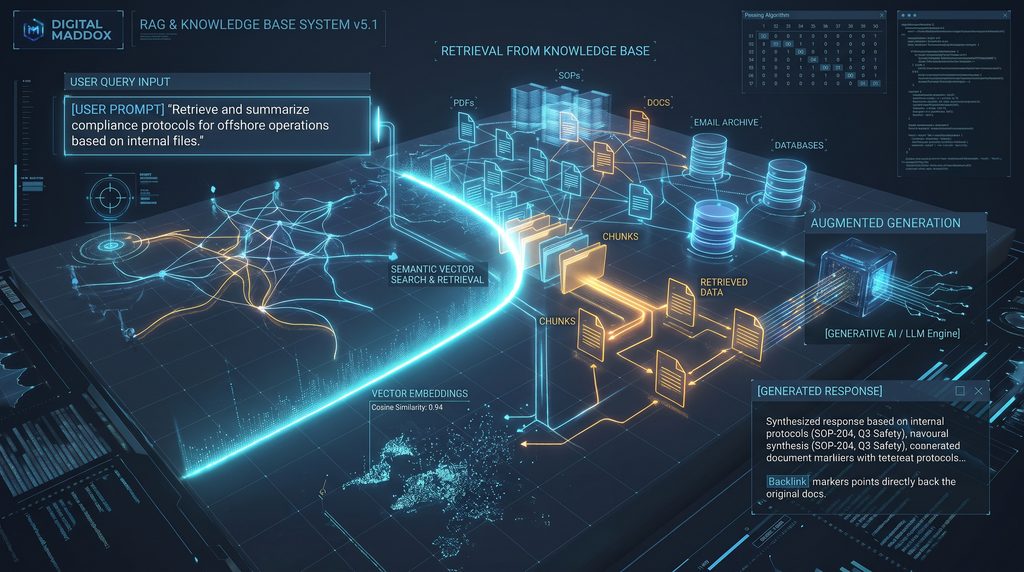
Digital Maddox designed and implemented an enterprise Retrieval-Augmented Generation (RAG) solution using Microsoft Azure.
The system combined automated document ingestion, optical character recognition (OCR), structured content extraction, vector embeddings, semantic retrieval, and large language models to enable users to interact with the organization’s knowledge base using natural language.
Rather than relying exclusively on information learned during a language model’s initial training, the RAG architecture retrieves relevant information from the organization’s own documents and supplies that context to the model when generating responses.
This approach helps ground AI-generated answers in organizational information while making large document collections easier to explore.
Technical Implementation
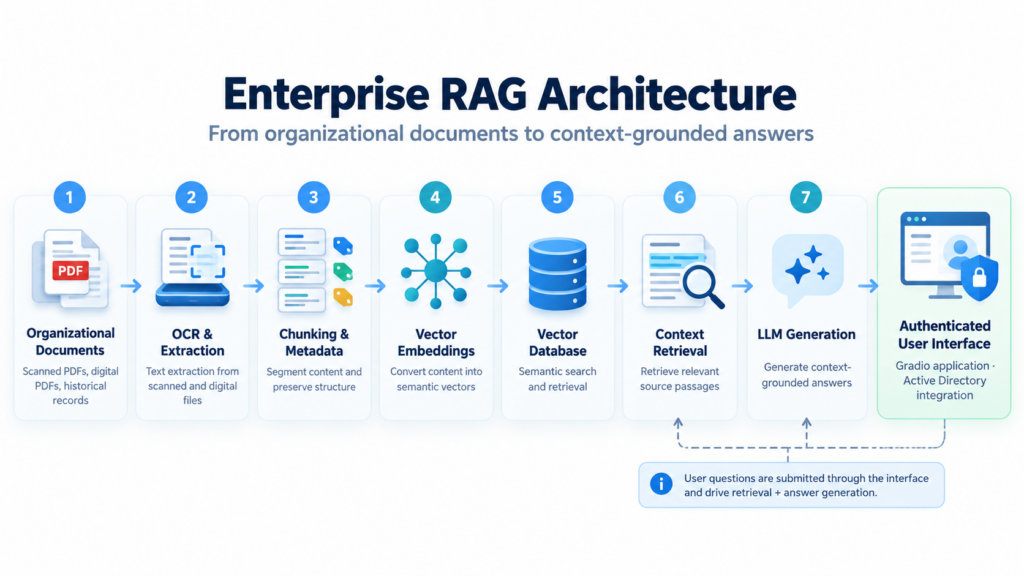
The solution incorporated several interconnected processing components:
Document Ingestion and Extraction
A document processing pipeline handled approximately 50,000 PDF files, including both scanned and digitally generated documents.
OCR was used where necessary to extract text from scanned material. Additional processing addressed documents containing complex tables so that tabular information could be searched and referenced independently rather than becoming lost within large blocks of extracted text.
Chunking, Embeddings, and Vector Retrieval
Extracted document content was divided into manageable segments and transformed into vector embeddings representing the semantic meaning of the text.
These embeddings were stored in a vector database to support similarity-based retrieval, allowing the system to identify relevant information even when user queries did not match the exact terminology used in the original documents.
Retrieval-Augmented Generation
When users submitted questions, the retrieval system identified relevant content from the indexed document collection and supplied that information as context to the language model.
The resulting workflow combined semantic document retrieval with natural language generation, enabling users to ask questions about internal information without having to locate and read every potentially relevant document manually.
Enterprise Integration and User Access
The solution included a user-facing application developed with Gradio and integrated with the organization’s Active Directory authentication environment.
This provided an authenticated interface for interacting with the knowledge base while incorporating the solution into the organization’s existing identity infrastructure.
Results and Capabilities
The implementation established an end-to-end document intelligence workflow capable of processing a large and diverse collection of organizational records.
Key capabilities included:
- Large-scale document processing: Ingestion and extraction across approximately 50,000 documents spanning three decades.
- Legacy document support: OCR and specialized processing for scanned records and documents containing complex tables.
- Semantic information retrieval: Searching for relevant information based on meaning rather than solely on exact keyword matches.
- Natural language interaction: Enabling users to ask questions against organizational documents through a RAG-powered interface.
- Enterprise authentication: Integrating user access with the organization’s existing Active Directory environment.
- Modular AI architecture: Separating document processing, vector retrieval, language model interaction, and the user interface into distinct functional components.
The project demonstrates how organizations can connect modern AI technologies to extensive collections of existing institutional knowledge.
Engineering Considerations
One of the important lessons from this work is that successful RAG systems depend heavily on the quality of their document processing and retrieval pipelines.
Scanned documents, inconsistent formatting, complex tables, and large collections of historical information introduce challenges that cannot be solved simply by connecting a language model to a vector database.
Document extraction, chunking strategies, metadata management, and retrieval design all influence the quality and usefulness of the information returned to users.
This project demonstrates Digital Maddox’s experience addressing these practical engineering challenges in an enterprise environment.
Unlock the Value of Your Organization’s Knowledge
Many organizations have valuable information locked away in document repositories, historical archives, policies, and technical publications.
Digital Maddox designs and develops AI-powered knowledge management solutions that integrate with existing infrastructure and help organizations access, analyze, and use information more effectively.
Whether your organization is exploring its first RAG application or looking to improve an existing AI knowledge system, we can help design an architecture suited to your data, security requirements, and operational needs.
Contact Digital Maddox to discuss your project.