
PROJECT CASE STUDY · AGENTIC AI & ENTERPRISE ARCHITECTURE
Engineering Reliable Agentic AI with LangGraph, MCP, and Deterministic Orchestration
Designing enterprise AI systems that combine the reasoning capabilities of large language models with controlled execution, modular tool integration, and layered security.

Project: Clairvoyint AI — Evidence-Grounded Analytical Agent.
Digital Maddox Role: AI architecture, agent orchestration, MCP integration, security engineering, and cloud infrastructure development.
The Challenge
Large Language Models (LLMs) have introduced powerful new capabilities for interpreting information, reasoning through complex problems, and interacting with external tools. However, integrating these capabilities into operational software presents significant engineering challenges.
Traditional AI agents often rely on language models to determine not only how to interpret a request, but also which tools to execute, what information to access, and how to proceed through multi-step workflows.
While this flexibility is useful, it introduces concerns about reliability, predictability, security, and reproducibility.
In enterprise environments, AI systems must operate within clearly defined boundaries. They need to respect authorization rules, validate inputs and outputs, handle errors appropriately, and preserve sufficient evidence to explain how analytical results were produced.
The central challenge is enabling AI-driven reasoning without surrendering control of application behavior to a probabilistic language model.
The Solution
Digital Maddox contributed key architectural and engineering components to Clairvoyint AI, a platform designed to transform expert analytical methodologies into reusable, evidence-grounded workflows.
The solution combines deterministic application control with flexible AI reasoning through a modular architecture built around LangGraph, custom orchestration services, and the Model Context Protocol (MCP).
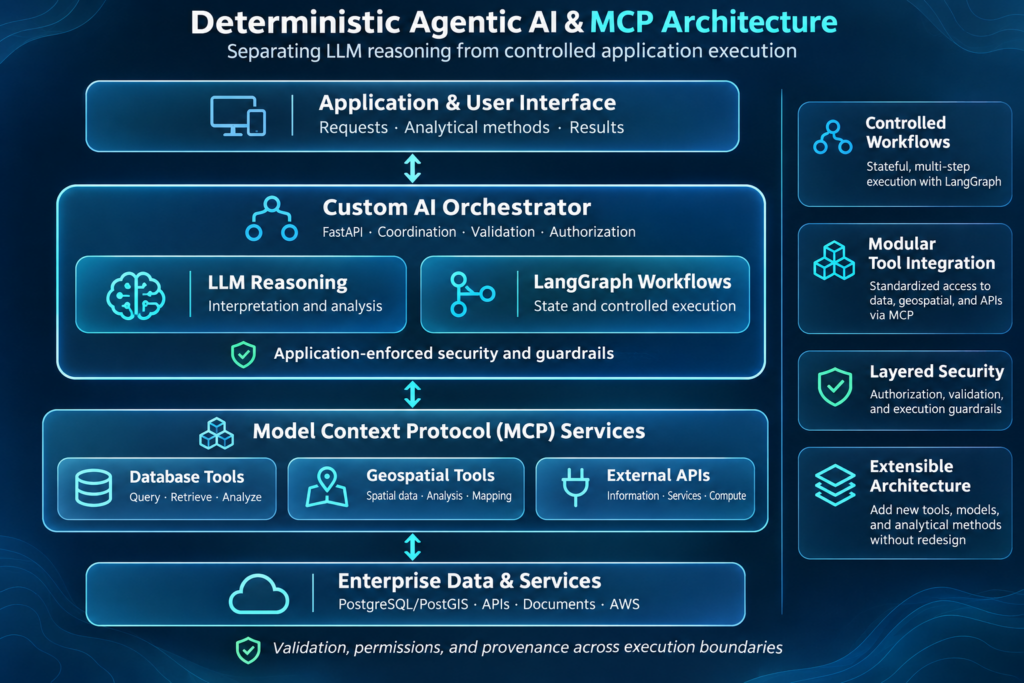
Rather than allowing an LLM to operate as an unrestricted autonomous controller, the architecture separates responsibilities among several components:
- Language Models: Interpret requests, reason about information, and produce analytical outputs.
- LangGraph Workflows: Coordinate stateful, multi-step analytical processes with defined execution paths.
- Custom AI Orchestrator: Manage interactions between workflows, models, tools, and application services.
- MCP Services: Provide standardized interfaces to external data sources, analytical capabilities, and computational tools.
- Security and Validation Layers: Enforce application-defined constraints on operations, data access, and tool execution.
This separation allows the AI system to take advantage of language-model capabilities while preserving control over how analytical workflows are executed.
Technical Implementation
Deterministic AI Agents with LangGraph
LangGraph provides the foundation for coordinating stateful AI workflows.
The architecture combines model-driven reasoning with explicit workflow definitions, allowing different stages of an analytical process to be managed through controlled transitions and application-defined logic.
For example, an analytical workflow may require information retrieval, source evaluation, additional computation, and final synthesis.
The language model can assist with interpreting retrieved information and generating analytical conclusions, while the workflow determines which steps are permitted, how state is maintained, and when validation is required.
This hybrid design supports complex, multi-step analytical tasks without relying exclusively on unrestricted model-generated actions.
Importantly, deterministic orchestration does not imply that language-model outputs themselves are deterministic. It means that the application retains control over workflow structure, execution boundaries, and authorization decisions.
Custom AI Orchestration
Digital Maddox designed and developed custom orchestration components using Python and FastAPI to coordinate interactions among agents, language models, and external application services.
The orchestrator provides a centralized architectural layer for managing these interactions while maintaining separation between the AI reasoning process and application-controlled operations.
This separation makes it easier to introduce new tools, integrate additional information sources, and modify underlying language models without redesigning the entire application.
It also provides defined locations within the architecture for validation, authorization, error handling, and operational controls.
Model Context Protocol (MCP) Integration
The architecture incorporates MCP services developed with FastMCP to expose application capabilities through standardized interfaces.
These services provide structured access to specialized functions, including database queries, information retrieval, geospatial operations, and other analytical tools.
By separating tool implementations from the orchestration layer, the system supports modular integration of existing and future capabilities.
For example, a geospatial analysis workflow may require access to spatial databases, geographic datasets, or processing services. MCP provides a standardized mechanism for making those capabilities available to authorized AI workflows.
The resulting architecture reduces tight coupling between the language model, application logic, and individual service implementations.
Security, Validation, and Guardrails
Security is a fundamental consideration when language models interact with applications and data.
LLM-generated outputs and retrieved source material cannot be assumed to be trustworthy instructions.
The architecture therefore incorporates multiple layers of protection, including:
- Controlled access to available tools and application capabilities.
- Application-defined authorization and workflow constraints.
- Structured validation of inputs, tool requests, and outputs.
- Separation of untrusted model-generated content from authoritative application instructions.
- Architectural defenses against prompt injection and unintended tool execution.
- Preservation of source context and provenance to support review and traceability.
These measures help reduce the risk that malicious or erroneous model-generated instructions could directly control application behavior.
The objective is not to assume that a language model will always follow security instructions correctly, but to design the surrounding software so that critical permissions and execution decisions are enforced independently.
Cloud Architecture and Integration
The supporting application architecture uses Amazon Web Services (AWS) to host independently deployed application components, orchestration services, APIs, and supporting data infrastructure.
The system integrates managed data services, API-based communication, network boundaries, and modular deployment patterns to support ongoing development and integration.
This architecture allows language-model capabilities, analytical workflows, and application services to evolve independently while maintaining well-defined interfaces between components.
Results and Capabilities
The work established foundational architectural components for an extensible, AI-assisted analytical platform.
Key capabilities include:
Controlled Multi-Step Analysis
LangGraph workflows provide structured execution paths for analytical tasks that require multiple reasoning and processing stages.
Standardized Tool Integration
MCP services provide modular interfaces to specialized databases, analytical functions, external APIs, and other application capabilities.
Flexible Model Integration
Separating model interactions from application logic reduces dependency on individual language-model providers and supports future changes to the AI technology stack.
Layered Security and Validation
Application-controlled authorization, execution constraints, and validation mechanisms help prevent untrusted AI output from directly controlling sensitive operations.
Evidence-Grounded Workflows
The architecture supports analytical processes in which source information, provenance, and supporting evidence remain connected to generated findings.
Modular Cloud Infrastructure
Independently deployed components allow the platform to incorporate additional capabilities without tightly coupling every service to the agent implementation.
Together, these capabilities provide a foundation for building AI-assisted analytical systems that are more controlled, maintainable, and reviewable than unrestricted agent implementations.
Engineering Considerations
One of the most important architectural lessons from this project is that effective enterprise AI development requires more than connecting a language model to a collection of tools.
Language models are valuable components, but they should not automatically become the authority responsible for every decision within an application.
By separating reasoning, orchestration, tool access, authorization, and data management, developers can build systems that maintain the flexibility of AI while enforcing operational requirements through conventional software engineering.
This approach is particularly valuable for analytical applications in which results must be supported by evidence, operations must be repeatable, and users need to understand how information was obtained and processed.
Broader Applications
The architectural patterns developed for this project can support a variety of enterprise applications, including:
- Geospatial Intelligence: Combining spatial databases, imagery, mapping services, and language-model reasoning within structured analytical workflows.
- Enterprise Research and Analysis: Coordinating information retrieval, evidence collection, analytical evaluation, and report generation.
- Operational Decision Support: Integrating AI reasoning with established business rules, data sources, and review procedures.
- Document and Knowledge Analysis: Combining retrieval-augmented generation with tool-enabled workflows and controlled information access.
- Data Engineering and Automation: Connecting AI-assisted processes to existing APIs, databases, and computational services.
These applications share a common requirement: allowing AI to assist with sophisticated tasks while keeping control of critical operations within the application architecture.
About Clairvoyint AI
Clairvoyint AI is developing a platform that transforms expert analytical methodologies into repeatable, evidence-grounded AI workflows.
Digital Maddox’s contributions include the design and development of key architectural components involving deterministic agent orchestration, Model Context Protocol integration, application security, and supporting cloud infrastructure.
The project demonstrates practical experience translating emerging AI technologies into structured, enterprise-oriented software architectures.
Building Reliable AI Systems for Your Organization
Digital Maddox specializes in developing custom AI architectures that integrate language models with existing applications, enterprise data, and specialized analytical capabilities.
Our work includes agentic AI systems, LangGraph orchestration, MCP service development, retrieval-augmented generation, secure tool integration, and cloud-based AI infrastructure.
Whether you’re developing a new AI-enabled application or looking to improve the reliability and security of an existing agentic system, Digital Maddox can help design and implement an architecture tailored to your requirements.
Contact Digital Maddox to discuss your project.