
PROJECT CASE STUDY · COMPUTER VISION & DEEP LEARNING
Computer Vision for Intelligent Image Search and Metadata Enrichment
Transforming large image collections into searchable information through automated object detection, optical character recognition, and database integration.
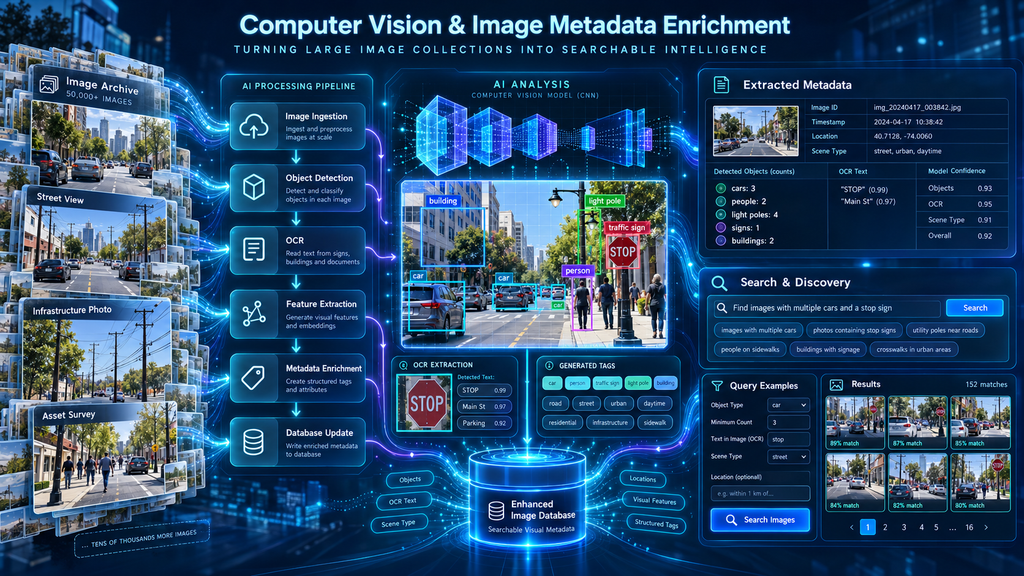
Project scale: Tens of thousands of photographs · Automated image analysis · Searchable metadata enrichment
The Challenge
Organizations frequently maintain extensive collections of photographs captured through field surveys, infrastructure inspections, mapping activities, and other operations. These images often contain valuable information about vehicles, people, signs, buildings, and physical infrastructure.
Unfortunately, much of this information remains inaccessible to traditional database search systems.
Image databases typically rely on manually entered descriptions, filenames, timestamps, geographic coordinates, or other existing metadata. While useful, these attributes often provide little insight into the actual contents of a photograph.
For a large photographic database containing tens of thousands of images, Digital Maddox developed a solution to automatically identify objects and extract visual information, making the existing collection significantly more useful for search and analysis.
The Solution
Digital Maddox developed a custom computer vision application using C++, OpenCV, and convolutional neural networks to analyze images and automatically enrich their associated database records.
The application examined photographs to recognize and classify objects such as vehicles, people, traffic signs, utility poles, and other physical features.
Optical Character Recognition (OCR) was also incorporated to extract text appearing on signs within the images.
Rather than simply generating a list of detected objects, the system integrated the extracted information directly into the existing database, allowing users to perform searches based on visual content that previously had not been represented in the stored metadata.
This approach added intelligent content discovery capabilities without requiring replacement of the organization’s existing image repository.
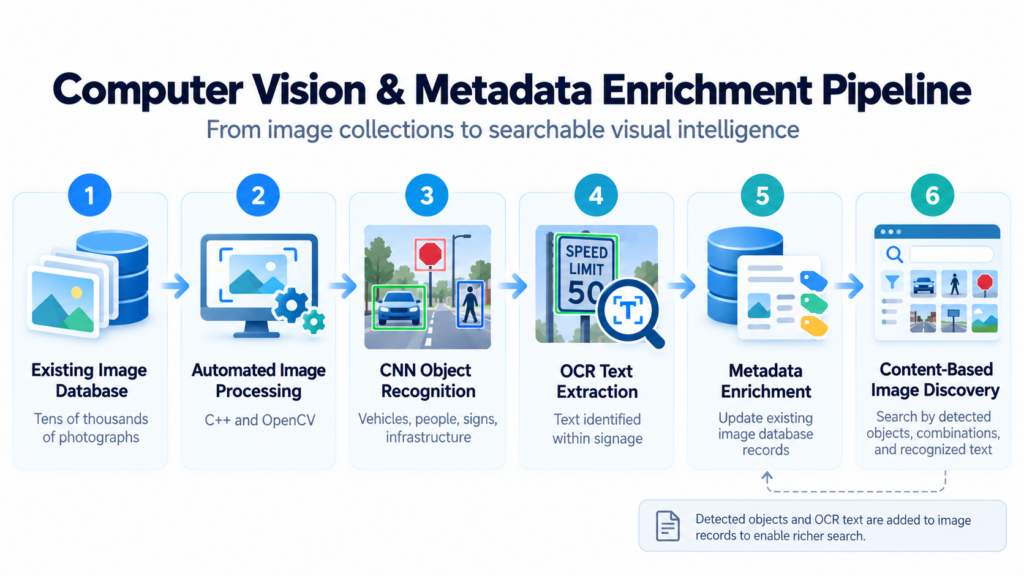
Technical Implementation
The application combined several technologies into an automated processing pipeline.
Image Processing and Object Recognition
Built in C++ using OpenCV, the application processed photographs from the existing image collection.
Convolutional neural networks were used to identify and classify recognizable objects, including vehicles, people, road signs, light poles, and other infrastructure.
These detections provided additional descriptive information about the contents of individual photographs.
Optical Character Recognition
In addition to identifying objects, the system incorporated OCR to extract text from signs appearing within photographs.
For example, identifying a traffic sign as an object provides useful metadata, but recognizing the text displayed on that sign makes the information more descriptive and searchable.
Combining object detection with OCR enabled richer interpretation of the visual content than object classification alone.
Automated Metadata Enrichment
The extracted information was integrated into the existing database as additional metadata associated with each photograph.
This allowed the system to preserve the original image records while extending the information available for querying and discovery.
Users could search for images containing specific objects, combinations of objects, or recognized signage, using information automatically generated by the computer vision pipeline.
Large-Scale Processing
The application was developed to work across a collection containing tens of thousands of images.
Automating the analysis and database enrichment process reduced the need for personnel to manually examine and describe every image when adding these categories of searchable information.
Results and Capabilities
The project demonstrated how computer vision could transform a traditional image repository into a searchable collection of structured visual information.
Key capabilities included:
- Automated Object Detection: Recognizing people, vehicles, signs, utility poles, and other objects within photographs.
- Text Extraction: Using OCR to identify and extract text appearing on signs.
- Metadata Enrichment: Adding newly discovered visual information to existing image database records.
- Content-Based Image Search: Supporting searches using objects detected in photographs rather than relying exclusively on manually entered metadata.
- Complex Search Criteria: Enabling searches for images containing combinations of objects, such as photographs showing multiple vehicles.
- Existing System Integration: Extending the capabilities of an established image database without replacing its underlying storage and management systems.
The result was a more capable information discovery system that could use the actual contents of photographs as searchable data.
Engineering Considerations
An important aspect of this project was the integration of multiple computer vision techniques into an existing information system.
Object detection and OCR address different types of visual information. By combining them, the application could generate a more complete representation of what appeared within a photograph.
Equally important was connecting those detections to the existing database. Computer vision results have limited operational value if users cannot efficiently retrieve and analyze them alongside their existing information.
The project illustrates Digital Maddox’s experience developing native computer vision applications and integrating deep learning capabilities into established data processing and information management workflows.
Broader Applications
The underlying approach can be applied to a wide range of industries and information management challenges.
Potential applications include:
- Infrastructure and Asset Management: Identifying equipment, signs, structures, and physical assets in photographic archives.
- Transportation and Street-Level Imagery: Searching photographs for vehicles, traffic signs, road features, and other infrastructure.
- Geospatial Intelligence: Combining image-derived observations with location information and other spatial datasets.
- Field Survey Automation: Extracting useful information from photographs collected during inspections and site surveys.
- Historical Image Archives: Making large collections of older photographs more accessible through automated content analysis.
These applications demonstrate how existing visual data assets can become more valuable when combined with modern computer vision and database technologies.
Unlock the Information in Your Image Collections
Your organization may already possess valuable information within thousands—or millions—of photographs that cannot be accessed through traditional database searches.
Digital Maddox develops custom computer vision, deep learning, and data integration solutions that help organizations extract useful information from visual data and incorporate it into existing applications and workflows.
Whether you’re working with infrastructure imagery, geospatial datasets, inspection photographs, or large archival collections, we can help explore how computer vision could make your data more useful.
Contact Digital Maddox to discuss your project.