
TextReferencer: Transforming Unstructured Text into Geospatial Intelligence
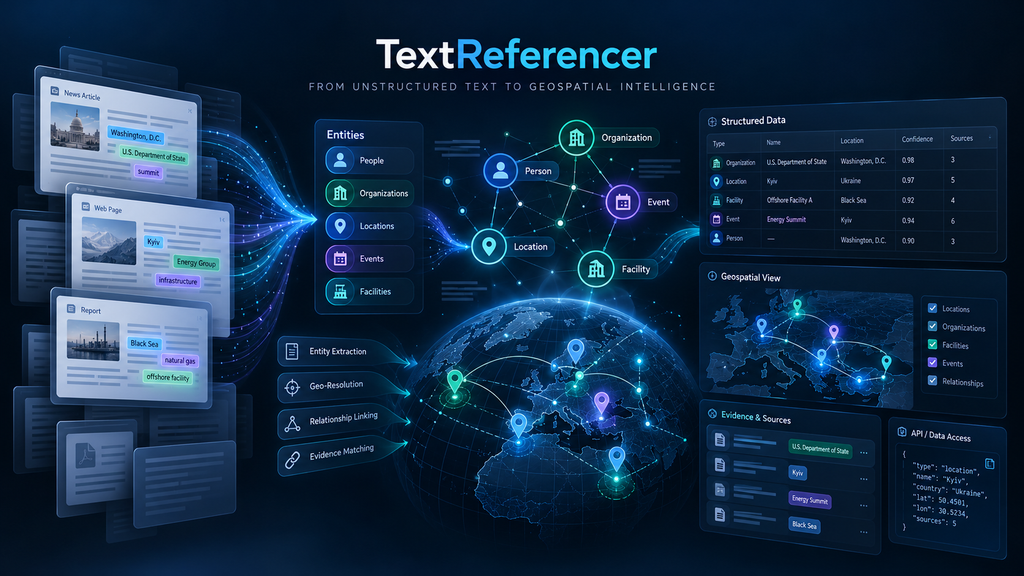
Organizations routinely collect enormous amounts of information from news articles, websites, reports, and other text-based sources. Unfortunately, much of this information remains unstructured, making it difficult to search, analyze, and integrate with existing geographic information systems.
Digital Maddox is developing TextReferencer, an information extraction and geographic entity resolution platform that transforms unstructured text into structured, geographically referenced information.
By combining natural language processing (NLP), named entity recognition (NER), geographic disambiguation, and spatial database technologies, TextReferencer helps connect information found in documents to real-world people, organizations, places, events, and infrastructure.
The Challenge
Unstructured information frequently contains valuable geographic and contextual information that traditional database and GIS systems cannot easily use.
A news article might describe an event near a particular city, mention several organizations and individuals, and identify nearby facilities. Although this information is meaningful to a human reader, extracting it automatically presents several challenges.
Location names can be ambiguous, the same entity may be referenced differently across sources, and important relationships may only be evident from the surrounding text. Additionally, extracted information needs to remain connected to its original source so that its accuracy and context can be evaluated.
Turning this information into reliable geospatial data requires more than simply identifying place names.
The Solution: TextReferencer
TextReferencer addresses these challenges through an automated information extraction and geographic processing pipeline.
The system combines several technologies and processing stages:
- Information Collection: Retrieve articles from RSS feeds and web-based information sources, extract their textual content, and identify previously processed material.
- Named Entity Recognition: Analyze the text to identify relevant entities, including people, organizations, geographic locations, facilities, events, and dates.
- Geographic Disambiguation: Evaluate geographic references against location datasets and contextual information to identify likely real-world locations. Geographic references that cannot be resolved confidently can be retained for further examination.
- Entity Relationships and Provenance: Maintain associations between extracted entities and the documents in which they were identified, preserving a connection to the underlying evidence.
- Spatial Data Integration: Store the extracted information in PostgreSQL/PostGIS, allowing it to be accessed through spatial queries, relational database operations, and GIS applications.
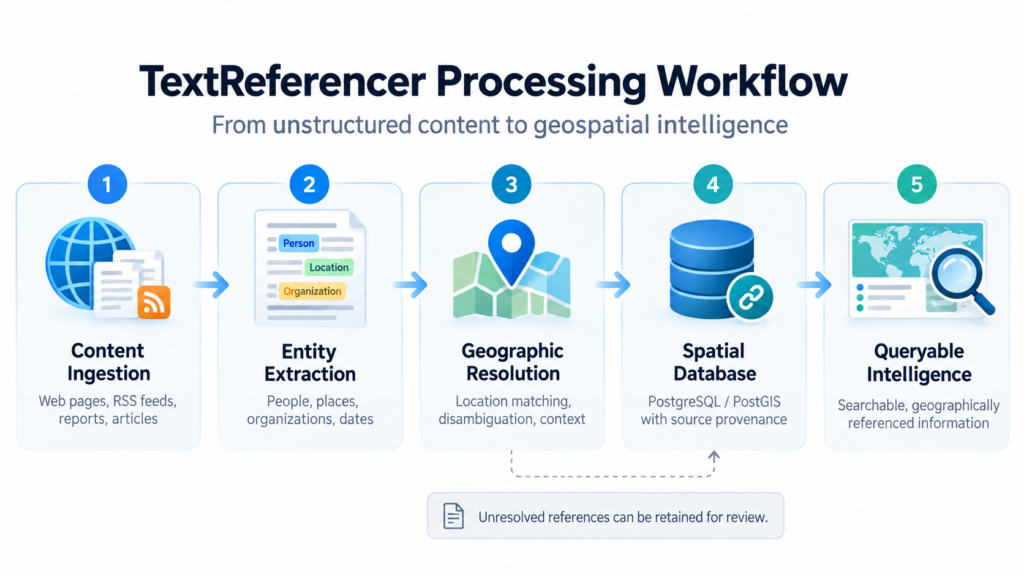
This approach transforms individual documents into a growing collection of structured, geographically searchable information while maintaining traceability to the source material.
Implementation and Technology
TextReferencer is implemented primarily in Python and integrates natural language processing, web content extraction, geographic resolution, and spatial database technologies.
The working prototype incorporates technologies including spaCy for named entity recognition, Trafilatura for web content extraction, geographic resolution components using Mordecai3 and GeoNames-backed data, and PostgreSQL/PostGIS for relational and spatial data management.
The application is designed around modular extraction and resolution components, allowing additional information sources and processing techniques to be incorporated as development continues.
An important design consideration is preserving uncertainty and source evidence rather than treating every extracted reference as an unquestionably correct geographic location.
Results and Capabilities
The working prototype demonstrates the ability to collect information from web and feed sources, extract meaningful entities, resolve geographic references, and persist source-linked information in a spatial database.
This enables several forms of analysis, including:
- Geographic information discovery: Identify articles and extracted entities associated with particular geographic areas.
- Entity and relationship exploration: Examine people, organizations, locations, and other entities referenced across collected information.
- Spatial and relational analysis: Combine text-derived information with existing GIS datasets through PostgreSQL/PostGIS.
- Source traceability: Examine the source documents associated with extracted information and investigate unresolved geographic references.
These capabilities provide a foundation for applications such as geospatial intelligence, situational awareness, information discovery, and event monitoring.
The structured information may also support future integration with retrieval-augmented generation (RAG) systems, AI agents, and other analytical applications that benefit from geographically grounded information.
Development Status
Working prototype — active development.
TextReferencer is an independently developed Digital Maddox project. Current development efforts focus on expanding information source support, improving geographic and entity resolution, and providing additional tools for reviewing, querying, and integrating extracted information.
The project demonstrates Digital Maddox’s experience integrating natural language processing, data engineering, geographic information systems, and AI into practical software solutions.
Have Unstructured Data That Could Benefit from Geospatial Intelligence?
Digital Maddox develops custom AI, NLP, and geospatial solutions that help organizations extract meaningful information from complex data sources and integrate it into their existing systems.
Contact Digital Maddox to discuss how information extraction and geospatial analysis could support your organization.